
Object Record
Images

Metadata
Object Name |
Kayak |
Date |
1920-1933 |
Material |
Leather/Wood |
Description |
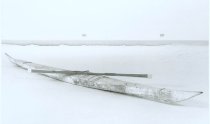
Greenland Kayak L: 17' B: 20"Wt: 40 lbs Built in the Umanak district of Greenland ca. 1933 "The kayak, in its highest state of evolution and in skillful hands, is perhaps the most seaworthy of all primitive small craft," wrote Howard I. Chapelle in 1964. 100 years before, "Rob Roy" MacGregor had appreciated the rapid and easy paddling, maneuverability and light weight of the kayaks of Greenland in choosing that New World form for his new Old World boat. If the shape of the traditional Arctic kayak influenced nineteenth century cruising canoes, native construction methods were entirely ignored. The strength of the kayak lies primarily in the deck, while the hull of a wooden canoe is supported by its frames, keel and stems. A kayak is covered with skin rather than wood. Kayaks, like birchbarks but unlike European-tradition boats, are built without plans or molds. This boat was acquired by the artist and writer Rockwell Kent (1882-1971) in Greenland in the early 1930s. It is built with sawn lumber and metal fastenings. Traditionally, the wood in kayaks was split by hand and the frame was lashed together. The Greenland kayak is built with a slight vee-bottom but this one has flattened out with age. |
Collection |
BBB110 |
Catalog Number |
1964.177.0001 |
Other number |
cat. no. 12 |
Imagefile |
055\1964.177.0001.JPG |
Species |
Kayak |
Owned by |
Kent, Rockwell |
Credit line |
Gift of Rockwell Kent |