
Object Record
Images
Metadata
Title |
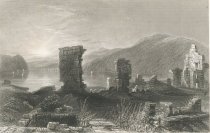
View of the Ruins of Fort Ticonderoga. |
Object Name |
|
Date |
1837 |
Artist |
Bartlett, William Henry |
Other Artist |
Prior, Thomas Abiel |
Description |
Engraving, black and white: view of the sun going down on the left. Sailboats in the water. There are mountains in the background. Three large clusters of stone framework. Four sheep are grazing nearby the ruins. Engraving found in Willis, "American Scenery" V. 1 (1840) |
Notes |
The name Ticonderoga comes from the Iroquois word tekontaro:ken, meaning "it is at the junction of two waterways". The fort was a popular subject for nineteenth century American artists who associated it with the ancient ruins of Europe. It became an important symbol of the nation's history and identity. Historic landmarks such as Fort Ticonderoga played a significant role in establishing the idea of the "great American landscape." Fort Ticonderoga, originally Fort Carillon, was built by the French military during the late 1750s to control a narrow portion of Lake Champlain alongside the mouth of the La Chute River between Lake Champlain and Lake George. Control of this strategic narrows meant control of the north-south water "highway". In 1759 the British defeated the French at Fort Carillon. In 1775, the fort was captured by Americans during the American Revolutionary War. It was recaptured by the British in 1777. It was abandoned and fell to ruin when it ceased to be of military value after 1781. In 1820, businessman, horticulturalist, and preservationist William Ferris Pell (1779-1840) purchased the ruins and grounds of Fort Ticonderoga to preserve them. In 1826, Pell constructed the Pavilion as his summer home, which in 1840 was converted to a hotel to accommodate the growing number of tourists visiting the ruins. |
Dimensions |
H-8.5 W-10.75 inches |
Collection |
ART PRINT Engraving |
Search Terms |
Ticonderoga ruins Essex County sheep |
Catalog Number |
1966.054.0001 |
Imagefile |
057\1966.054.0001.JPG |
Species |
|
Credit line |
Gift of Mrs. Douglas Delanoy |